Attic Insulation: How to Compare R-Value, Air Sealing, Ventilation, and Cost
Attic insulation is often one of the first efficiency upgrades homeowners consider because the attic is relatively accessible and sits between conditioned rooms and extreme outdoor temperatures. But adding insulation only makes sense after checking what is already there, how much air leakage exists, whether moisture is present, and whether ventilation or combustion issues need attention.
The best attic project treats insulation as one part of the roof-and-ceiling system rather than simply adding more material.
Table of Contents
Measure existing insulation first
The U.S. Department of Energy’s Energy Saver insulation guidance explains that recommended insulation levels depend on climate and building assembly.
Record insulation type, depth, coverage, condition, and whether it has been compressed, displaced, wet, or contaminated.
Air sealing usually comes before adding insulation
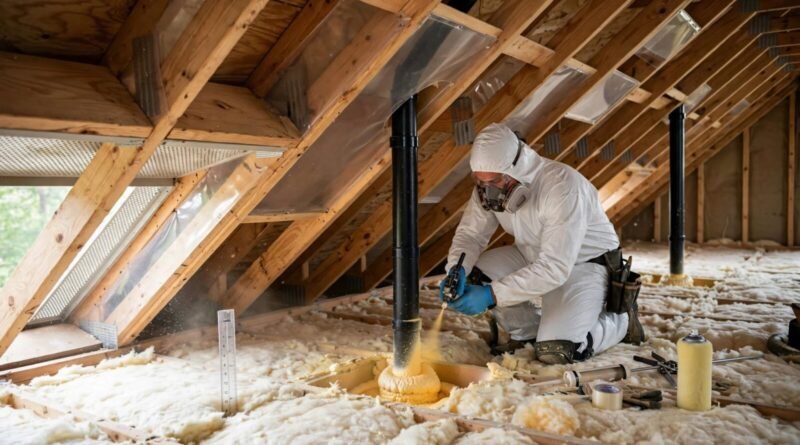
Plumbing penetrations, wiring holes, attic hatches, top plates, recessed fixtures, and open chases can leak conditioned air into the attic.
If you bury these leaks under new insulation, future sealing becomes harder. Air-seal accessible penetrations before topping up insulation.
R-value is not the whole story
R-value measures resistance to heat flow. But framing, air leakage, installation gaps, compression, and thermal bridges all affect whole-assembly performance.
A deep layer of poorly installed insulation can underperform a more carefully installed assembly.
Ventilation needs context
Attic ventilation can help manage heat and moisture in many roof assemblies, but the correct configuration depends on climate and construction.
Do not block soffit vents with insulation. Use baffles or other appropriate detailing where ventilation channels must remain open.
Moisture problems come first
Roof leaks, bathroom exhaust discharged into the attic, plumbing leaks, or condensation can wet insulation and roof decking.
Correct the moisture source before adding material. New insulation does not fix a leaking roof or bad exhaust duct.
Recessed lights and heat sources need safe clearances
Some fixtures and equipment have clearance requirements. Electrical and fire-safety rules matter when insulation is installed around lights, flues, chimneys, and other heat-producing components.
Use products and installation methods appropriate to the equipment and local code.
A hypothetical project comparison
Suppose Contractor A quotes $2,800 to blow additional insulation over the existing attic. Contractor B quotes $4,200 and includes air sealing, attic-hatch weatherstripping, ventilation baffles, insulation, and post-work verification.
The second quote is not simply “more insulation.” It includes work that can materially affect performance.
These figures are illustrative.
Insulation type should fit the application
Fiberglass, cellulose, spray foam, rigid foam, and other materials have different installation methods, vapor behavior, air-sealing properties, fire requirements, and costs.
Do not choose solely by advertised R-value per inch.
Spray foam changes the roof assembly
Foam applied at the roof deck can change the attic from vented to conditioned or semi-conditioned depending on design. This can affect moisture behavior, roof inspection, HVAC location, and future repairs.
Use experienced professionals who understand the assembly rather than treating foam as a simple substitute for loose-fill insulation.
Ducts in the attic can change priorities
Leaky or poorly insulated ducts running through a hot or cold attic can waste energy and create comfort problems.
Inspect and seal ducts where needed before burying them or making access difficult.
Energy savings should be property-specific
Savings depend on the starting insulation level, climate, heating and cooling system, air leakage, utility rates, and the amount of conditioned space below the attic.
Do not rely on a universal savings percentage.
Rebates may be available
Utilities and government programs sometimes support qualifying insulation projects. Rules change, so verify current eligibility through official sources before including an incentive in the budget.
Internal Earnyx comparison
Earnyx’s insulation versus new windows analysis explains why improving a deficient attic can be a stronger value than replacing functional windows solely for energy savings.
Compare attic-insulation quotes
Record:
- existing conditions;
- target R-value;
- air-sealing scope;
- material;
- ventilation details;
- attic hatch treatment;
- duct work;
- moisture corrections;
- cleanup;
- and verification.
Bottom line
Attic insulation is most effective when the attic is actually under-insulated and when major air leaks and moisture problems are corrected first.
Measure the starting condition, preserve safe ventilation and equipment clearances, air-seal before covering penetrations, and compare the complete attic system. More insulation is useful only when the assembly underneath it is working correctly.