
Mold Remediation Costs: How to Price Cleanup Without Ignoring the Moisture Problem
Mold remediation cost depends on far more than the visible area of staining. The project can involve finding and stopping the moisture source, containing contaminated areas, removing porous materials, cleaning salvageable surfaces, drying the structure, repairing damaged finishes, and verifying that the underlying water problem is actually solved.
The most important financial rule is simple: paying for mold removal without fixing moisture is paying for the same problem twice.
Table of Contents
Moisture control comes first
The EPA’s mold guidance emphasizes that moisture control is the key to mold control. Mold can grow when building materials remain damp, so cleanup should be paired with correction of leaks, condensation, flooding, drainage, or humidity problems.
A remediation quote that does not address why the area became wet is incomplete.
Visible mold does not define the entire scope
Growth can exist behind drywall, under flooring, around insulation, inside cabinets, or in other concealed areas where moisture traveled.
That does not mean every wall should be demolished. It means the remediation scope should be based on moisture history and inspection, not simply the dimensions of one visible patch.
Small areas and large projects are different
EPA guidance distinguishes smaller routine cleanup from larger or more complex situations. Extensive contamination, sewage, HVAC involvement, or significant water damage may require more specialized procedures and professional judgment.
Homeowners should not rely on one universal “price per square foot” for every mold event.
Testing is not always the first expense
EPA notes that if visible mold is present, sampling is often unnecessary simply to confirm that mold exists. Testing can be useful in specific situations, but the value depends on the question being asked.
Before paying for broad testing, ask what decision the result will change.
Containment can add labor
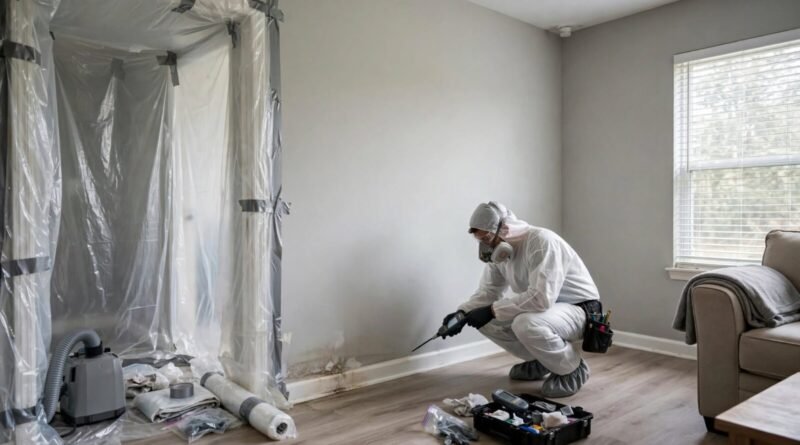
Professional remediation can involve isolating work areas, controlling dust, using negative pressure, protecting adjacent rooms, and safely handling removed materials.
A low bid that simply sprays or wipes visible growth is not equivalent to a contained removal project.
Porous materials may need removal
Drywall, ceiling tile, insulation, carpet padding, and other porous materials can be difficult to clean once heavily contaminated.
The restoration cost after removal should be separated from the remediation cost so homeowners can compare complete project totals.
A hypothetical quote comparison
Suppose Company A quotes $2,500 to treat visible mold in a basement. Company B quotes $6,000 and includes containment, removal of damaged drywall and insulation, drying, disposal, and post-remediation cleaning—but neither quote includes fixing the leaking foundation crack.
The homeowner still needs a separate water-repair budget before either proposal is truly complete.
These figures are illustrative.
Humidity can be the driver
Bathrooms, basements, crawlspaces, and poorly ventilated rooms can develop mold when humidity remains high even without a dramatic leak.
Ventilation, dehumidification, air conditioning, and source control may need to be part of the long-term solution.
Flood and sewage events require additional caution
Floodwater and sewage can introduce contaminants beyond mold. Cleanup methods and personal protective measures may differ from an ordinary condensation-related mold problem.
Follow public-health and local professional guidance for contaminated-water events.
HVAC contamination is a separate issue
If mold is suspected in ductwork or HVAC equipment, do not assume the same surface-cleaning approach applies. The source of moisture and affected components need evaluation.
A remediation company should explain why HVAC treatment is or is not included.
Insurance depends on why the mold occurred
Coverage can depend on whether the underlying water event was covered, excluded, gradual, or maintenance-related. Mold sublimits or exclusions can also apply.
Earnyx’s insurance exclusions guide explains why the cause of loss matters more than the word “mold.”
Do not use bleach as a universal answer
EPA does not recommend simply treating mold with biocides as a substitute for removing contamination and fixing moisture. Dead mold can still be allergenic, and porous materials may remain affected.
The project should focus on physical removal, cleaning, drying, and moisture control.
Post-remediation verification should have a purpose
Verification can include visual inspection, moisture measurements, or other checks appropriate to the project. Air testing is not automatically required for every job.
Ask what success criteria the contractor will use before work begins.
Normalize remediation bids
Compare:
- moisture-source diagnosis;
- containment;
- materials removed;
- cleaning method;
- drying equipment;
- disposal;
- HVAC scope;
- verification;
- finish restoration;
- and exclusions.
Bottom line
Mold remediation cost is the cost of removing contamination and fixing the conditions that allowed it to grow.
Start with moisture, define the affected materials, compare containment and restoration scopes, and avoid paying for unnecessary testing that will not change the plan. A clean-looking wall is not a successful remediation if the water problem remains behind it.