
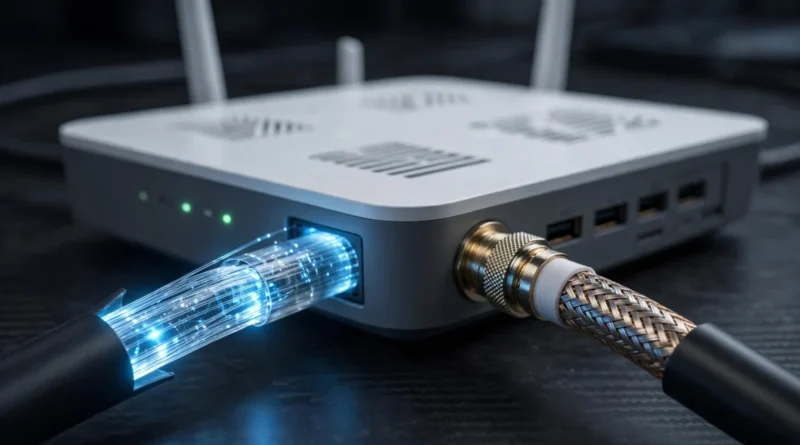
Fiber vs Cable Internet: Which Connection Is Better Value?
Table of Contents
01 Event
Fiber and cable are two of the most common high-speed home internet options where both are available. Cable often has broad coverage and competitive promotional pricing, while fiber is marketed around high capacity and symmetrical performance. The better value is not automatically the newer technology; it depends on the plans actually available at your address, their total cost and how your household uses the connection.
02 What Changed?
Fiber deployment has expanded, giving more households access to connections that send data using light through fiber-optic lines. Cable networks have also improved, offering much higher download speeds than older generations. As a result, both technologies can provide more than enough downstream capacity for ordinary streaming, browsing and gaming.
The bigger distinction often appears upstream. Many fiber plans provide similar upload and download speeds, while cable plans frequently allocate much less capacity to uploads. Network architecture and local conditions can also affect congestion and latency.
03 Why It Matters
A household can easily overfocus on headline download speed. If both a 500 Mbps cable plan and a 500 Mbps fiber plan handle streaming equally well, differences in upload speed, equipment fees, promotional pricing, reliability and contract terms may decide the better value.
Fiber can be particularly useful for frequent large uploads, cloud backups, creators and homes with several simultaneous video calls. Cable can remain an excellent choice when it is substantially cheaper, reliable locally and provides enough upstream capacity for the household.
04 What It Means for You
Compare exact offers at your address rather than technologies in the abstract. Record the regular monthly price after promotions, installation charges, equipment rental, data limits, upload speed and cancellation terms. Ask whether the quoted rate requires autopay, paperless billing or bundled services.
Look at reliability in your specific area. A theoretically superior network does not help if installation is poor or local service is inconsistent. Likewise, replacing a stable cable connection solely because fiber is available may not create noticeable value if your workload is modest.
If you work from home or upload large files, give upstream performance more weight. If your use is mostly streaming and browsing, pricing and service quality may matter more than symmetry.
05 Numbers + Context
Suppose cable costs $55 per month for the promotional year and then $80, while fiber costs $70 consistently. Over two years, ignoring fees, cable totals $1,620 and fiber totals $1,680—a difference of only $60. If fiber also includes equipment while cable adds a $10 monthly rental, the cost comparison reverses. Promotional prices can therefore obscure the longer-term economics.
For technical and consumer context, consult provider broadband disclosures, regulator broadband resources and the exact service terms offered for your address. Advertised maximum speeds are less useful than the complete plan characteristics.
06 Earnyx Takeaway
Fiber generally has structural advantages in capacity and often in upload performance, but cable can still be the better purchase when it is cheaper and meets your needs reliably. Compare the complete two- or three-year cost and the performance dimensions your household actually uses. Technology labels matter less than the service delivered for the price.