
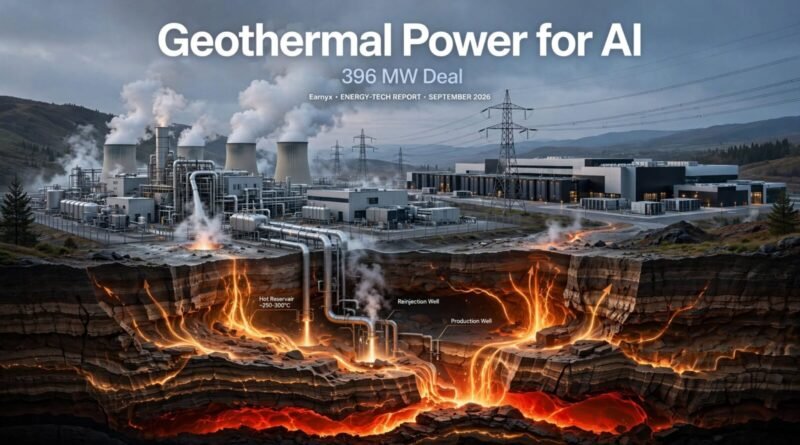
Google Signs 396-MW Geothermal Power Deal With Fervo as Data-Center Demand Grows
Table of Contents
01 Event
Google has signed a deal with geothermal developer Fervo Energy for 396 megawatts of power from Fervo’s Cape Station project in Utah. The agreement is another sign that large technology companies are looking for reliable, around-the-clock electricity supplies as data-center demand rises.
Reuters reported that Fervo shares rose nearly 14% in premarket trading after the deal was announced. The agreement links two trends that are increasingly difficult to separate: the expansion of AI and cloud-computing infrastructure, and the search for new sources of power that can operate more consistently than weather-dependent generation.
Google background video: how its earlier Fervo enhanced-geothermal project works. This provides technology context for the new 396-MW Utah agreement.
02 What Changed?
Technology companies have spent years signing renewable-power agreements, but the electricity profile of data centers creates a specific challenge. Servers operate continuously, and large AI facilities can consume substantial amounts of electricity at all hours.
Solar and wind power can provide low-carbon electricity, but their output varies with weather and time of day. Geothermal energy is attractive because it can produce power around the clock when the underlying geology and project design support it.
The 396-MW Fervo agreement therefore matters because it is not simply another renewable-energy purchase. It is part of the broader effort to secure dependable electricity for data-center growth.
Earnyx has been tracking the same pressure through AI data-center power and water costs and the broader shift described in Europe and Asia’s push toward renewables during an energy crisis.
03 Why It Matters
Data-center expansion is turning electricity procurement into a strategic technology issue. AI companies can buy more chips and servers, but those machines are useful only if facilities can obtain enough electricity, grid connections, cooling and backup capacity.
That means power developers increasingly benefit from technology-sector demand. Projects that can deliver large volumes of electricity with predictable output are especially valuable to companies trying to reduce carbon emissions without sacrificing reliability.
Geothermal also has a different physical footprint from many other renewable technologies. It does not require sunlight or wind at the moment power is needed. The tradeoff is that projects depend on suitable underground conditions, drilling expertise and large upfront investment.
04 What It Means for You
For consumers, this is not likely to change a Google service bill tomorrow. The more important issue is how quickly data-center electricity demand grows relative to new generation and grid capacity.
If technology companies fund or contract new power projects, they can help bring additional generation online. If demand grows faster than supply, however, data centers can add pressure to regional grids and infrastructure investment.
For investors and energy customers, the deal is another signal that geothermal is being evaluated not only as a niche renewable source but as a potential supplier for large industrial loads that need continuous power.
05 Numbers + Context
The supply agreement covers 396 megawatts from Fervo’s Cape Station geothermal project in Utah. Reuters reported that Fervo shares rose nearly 14% in premarket trading following the announcement.
A megawatt is a measure of power capacity, not annual energy consumption, so 396 MW should not be read as the amount Google will use every hour regardless of conditions. The key point is the scale of the contracted capacity and its value as an around-the-clock source.
The deal comes during a period of extraordinary data-center investment. In a separate Earnyx report, AI-related data-center spending was tracked at more than $700 billion, illustrating why electricity availability is becoming one of the limiting factors in the AI expansion.
06 Earnyx Takeaway
Google’s deal with Fervo shows that the AI infrastructure race is not only about chips. It is increasingly about power.
For technology companies, securing large blocks of dependable electricity is becoming part of the cost of staying competitive. For energy developers, the rise of AI creates a new class of customers willing to sign major long-term supply agreements.
The practical question is whether projects like Cape Station can add enough reliable power quickly enough to keep pace with data-center demand without simply shifting costs and grid pressure elsewhere.
For future deals, the most useful figures to watch will be contracted capacity, project completion dates, actual generation once facilities are operating, and how much new grid infrastructure is required to deliver the electricity. Those measurements tell us more than a headline agreement alone. A large contract can signal demand, but the economic and grid impact becomes clearer only as the generation project is built and begins supplying power.
Source: Reuters, September 1, 2026.



Pingback: Google’s $15 Billion Finland AI Investment and Nuclear Power Deal