
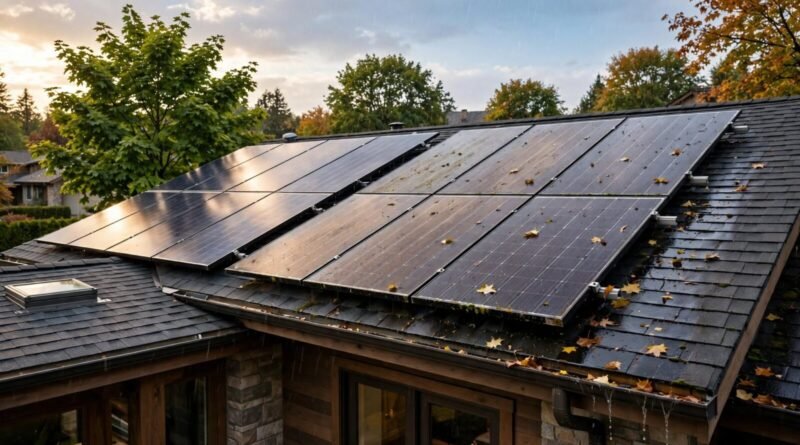
Solar Panel Degradation: How Much Output Do Panels Really Lose Over Time?
Table of Contents
01 Event
Solar panels are designed to produce electricity for decades, but they do not remain at their original output forever. Exposure to heat, weather, ultraviolet light and repeated thermal cycling can gradually reduce photovoltaic module performance. This process is known as degradation, and it matters because solar payback calculations often depend on decades of future electricity production.
Long-term photovoltaic research from the National Renewable Energy Laboratory shows why degradation belongs in lifetime-energy modeling rather than being ignored. Manufacturers also publish performance warranties that specify minimum retained output over time, but a warranty threshold and expected real-world production are not the same thing.
02 What Changed?
Modern residential solar proposals often include long performance-warranty periods and annual degradation assumptions. That makes it easier to compare modules, but the smallest advertised degradation percentage should not automatically determine the purchase.
Homeowners need to distinguish between module degradation and total system production. Actual energy also depends on weather, shading, inverter performance, soiling, roof changes, equipment downtime and household system design. A gradual decline in panel capability is only one part of long-term output.
03 Why It Matters
Small annual losses compound. A system producing 10,000 kilowatt-hours in its first full year will not necessarily produce 10,000 every year thereafter. If output declines gradually, the household may buy more electricity from the utility as the system ages. That reduces lifetime savings compared with a model that assumes flat production forever.
Degradation also matters when comparing premium and standard panels. A more expensive module with a stronger long-term performance guarantee may preserve more lifetime electricity, but that extra production has to be worth more than the price premium.
Roof space can change the answer. Where usable roof area is limited, higher-efficiency modules may create value independent of degradation because more generating capacity can fit into the available space.
04 What It Means for You
When reviewing solar proposals, ask what annual degradation assumption is built into the production forecast. If a model assumes no decline at all, ask the installer to explain why. The forecast should also make clear whether it treats the first-year change differently from later years.
Compare product warranties and performance warranties separately. A product warranty generally addresses defects, while a performance warranty establishes a minimum output level over time. Read the actual terms, including exclusions and whether labor, diagnostics, shipping or removal costs are covered.
Monitoring matters because a sudden production decline is different from normal aging. Inverter faults, new shade, dirt, wiring problems or outages can reduce energy much faster than expected degradation. Year-over-year monitoring helps identify changes that deserve investigation.
Solar economics also depend on system sizing and future electricity use. Earnyx’s solar system sizing guide explains why matching capacity to household demand matters before comparing long-term panel output.
05 Numbers + Context
Use the degradation rate in your actual proposal to model lifetime energy rather than relying on a generic number. The calculation is straightforward:
Future annual output = starting annual output × (1 − degradation rate)years
If the proposal assumes 10,000 kWh in the starting year and an annual degradation rate of 0.5%, the model would estimate roughly 9,560 kWh after nine additional annual declines and about 8,870 kWh after twenty-four. Those are mathematical illustrations of the assumption—not a claim that every panel degrades at exactly 0.5%.
To compare a premium module, calculate the lifetime electricity preserved by its lower degradation assumption and multiply that energy by a reasonable estimate of the value of electricity during those years. Then compare that benefit with the actual installed-price difference.
| Question | Why it matters |
|---|---|
| What degradation rate is modeled? | Changes projected lifetime generation |
| What does the performance warranty guarantee? | Sets the manufacturer’s minimum contractual threshold |
| What does the product warranty cover? | Determines protection against defects |
| Are labor and service included? | Affects the real cost of a warranty claim |
| Is roof space constrained? | Can make efficiency more valuable |
06 Earnyx Takeaway
Solar panel degradation is real, but the financial mistake is either ignoring it completely or paying a large premium to reduce it without calculating what the preserved electricity is worth.
Use the degradation assumption in the installer’s production model, compare warranty language carefully and monitor actual system output. If a premium panel preserves additional lifetime production, put a dollar value on that benefit before deciding whether the higher upfront price is justified.
The best panel is not automatically the one with the smallest degradation number. It is the module whose price, efficiency, expected production, warranty and service support produce the strongest total value for the specific roof.

Pingback: Solar Panel Efficiency: When Is Paying More Worth It?